Fishing Catch and Size Limits: What Can You Keep?
Most anglers return everything they catch, but if you want to keep fish there are strict daily limits, minimum and maximum sizes, and some fish you must always put back.
By Steve Dyke, Founder and editor
Updated
· Last reviewed · 3 min read
In short
- From rivers in England you can take up to 15 small coarse fish of no more than 20cm, 2 grayling between 30cm and 38cm, and 1 pike of no more than 65cm each day.
- You need the owner's permission to remove any fish from stillwaters, canals, club waters and private fisheries.
- All eels must be returned to the water unharmed.
- All salmon caught before 16 June must be released, and rod-caught salmon and sea trout can never be sold.
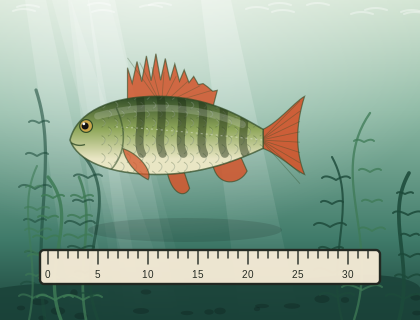
- Measure a fish from the tip of the snout to the fork of the tail.
How many fish can I keep from a river?
England's national byelaws set a daily limit for coarse fish on rivers, streams and drains, and on a short list of named canals and stillwaters (including Windermere, Coniston Water, Ullswater, Derwentwater and the Norfolk Broads). Each day you can take:
- a total of 15 coarse fish of no more than 20cm, from barbel, chub, common bream, common carp, crucian carp, dace, perch, pike, roach, rudd, silver bream, smelt and tench (including hybrids);
- 2 grayling between 30cm and 38cm;
- 1 pike of no more than 65cm.
You can also take non-native species, ornamental varieties, minnow, loach, bleak, gudgeon, bullhead, stickleback and ruffe from rivers, streams and drains.
In other words, the law protects the larger breeding fish: you can't legally take a big chub, barbel or carp from an English river at all.
Can I keep fish from a lake or canal?
Only with the fishery owner's permission. On stillwaters and canal fisheries you need permission to remove fish, and most commercial fisheries and clubs are strictly catch and release. Day tickets sometimes state their own limits; follow whichever rule is stricter.
Which fish must always go back?
- Eels and shad must be returned to the same water unharmed. See eel fishing rules.
- Salmon caught before 16 June must be released immediately with the least possible injury, and in Wales all salmon must be released. See salmon and sea trout.
- Foul-hooked fish (hooked anywhere other than the mouth or throat) caught in rivers, streams, drains or canals must be released immediately.
- Any fish over the limit, or outside the size range, must be returned with as little injury as possible.
How do you measure a fish?
Measure from the tip of the snout to the fork or cleft in the tail (the "fork length"), not to the end of the tail fin. Lay the fish on a wet mat beside a ruler or measuring board, measure quickly and return it promptly.
What are the trout and salmon size and bag limits?
Trout and salmon limits are set by each byelaw area and sometimes by individual rivers, so check the area byelaws on GOV.UK. For example, the North East byelaws make it illegal to take trout shorter than 23cm in the Yorkshire area. Most game fisheries also set their own bag limits on tickets.
What are the keepnet rules?
If you use a keepnet, it must be at least 2 metres long, with knotless, non-metallic mesh whose holes are no larger than 25mm in circumference. Fish you cannot legally keep must be returned alive before or when you finish fishing, and you can be fined for leaving fish in a keepnet or keepsack after you stop. A keepsack can hold only one fish.
Can I sell fish I catch?
It is illegal to sell, or keep with the intention of selling, any salmon or sea trout caught with a rod and line. Taking fish from one water and moving them to another, alive, needs written Environment Agency permission.
What is the penalty?
Taking too many fish or fish of the wrong size is an offence. Byelaw breaches can bring a fine of up to £50,000. If you see illegal fishing, report it to the Environment Agency incident hotline on 0800 80 70 60. Next, read about close seasons.
Questions and answers
Can I keep the fish I catch?
Only within the limits. From rivers you can take up to 15 small coarse fish of no more than 20cm, 2 grayling and 1 pike a day; you need the owner's permission to take fish from lakes and canals; and all eels must go back. See catch limits.
Sources and further reading
Didn't find your answer?
Ask us about rod licences, seasons or fishing rules and we'll add the answer to the site. For your own licence account, contact the Environment Agency directly.