Fishing Tackle Explained: Rods, Reels and Floats
What each piece of fishing tackle does, which floats to start with, and the legal rules on lead weights and rods.
By Steve Dyke, Founder and editor
Updated
· Last reviewed · 3 min read
This page contains affiliate links to fishing tackle. If you buy through them we may earn a commission, at no extra cost to you. We never sell fishing licences. How we make money
In short
- A float rod, a fixed-spool reel, a few floats, hooks and split shot are all a beginner needs.
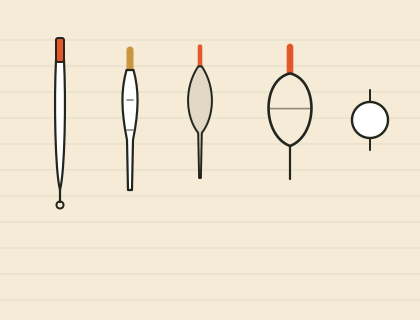
- Waggler floats are attached at the bottom only and suit lakes; stick and avon floats are attached top and bottom and suit flowing rivers.
- In England it's illegal to use lead weights between 0.06g and 28.35g (1oz) on a fishing line.
- Your licence limits how many rods you fish at once, but spod and marker rods don't count unless hooked.
What kinds of fishing rod are there?
- Float rod (match rod)
- Long (10 to 13ft) and light, for float fishing on lakes, canals and slow rivers. The best all-round first rod.
- Feeder rod
- A rod with interchangeable sensitive tips that show bites when fishing a swimfeeder on the bottom.
- Carp rod
- A powerful rod rated by "test curve" (often 2.75 to 3.5lb), for casting heavy leads and playing big fish. Usually fished in pairs or threes; see carp fishing.
- Spinning or lure rod
- A shorter rod for casting lures to pike, perch and sea bass.
- Fly rod
- Rated by line weight (for example "6-weight"); casts a weighted fly line rather than a weight. See trout and fly fishing.
- Pole
- A long rod with no reel, the line fixed to the tip; used in match fishing for precise presentation.
What kinds of reel are there?
- Fixed-spool reel
- The spool faces forward and doesn't turn when you cast, so tangles are rare. Used for most coarse, carp and lure fishing, and the easiest reel to learn with.
- Baitrunner or free-spool reel
- A fixed-spool reel with a lever that lets a fish take line freely; standard for carp and pike.
- Fly reel
- A simple drum that stores the fly line and backing.
- Centrepin
- A free-running drum reel loved by river anglers for trotting a float.
- Multiplier
- A geared reel used mostly for boat and beach sea fishing.
Which float should I use?
| Float | How it's attached | Best for |
|---|---|---|
| Waggler | Bottom end only | Lakes and canals, still or windy water |
| Stick float | Top and bottom | Steady-paced rivers, running a bait downstream |
| Avon | Top and bottom | Faster, deeper rivers |
| Pole float | Top and bottom, on a pole rig | Precise close-range fishing |
| Pike float | Sliding or fixed | Suspending dead or live baits for pike |
A pack of mixed waggler floats covers most stillwater fishing.
Hooks, weights and other bits
- Hooks are sized by number: the bigger the number, the smaller the hook. Size 16 to 18 suits maggots; size 10 to 14 suits corn and pellets. Barbless hooks are required on many fisheries.
- Split shot are small weights pinched on the line to cock the float. Use lead-free shot, or lead no bigger than size 8.
- Disgorger: a simple tool to remove hooks safely. Always carry one.
- Plummet: a weight for finding the depth before you fish.
- Landing net and unhooking mat: for landing and handling fish without damage.
What are the lead weight rules?
England's national byelaws ban lead weights attached to a fishing line other than those of 0.06g (size 8 shot) or less, or more than 28.35g (1oz). This protects swans and other waterbirds, which can be poisoned by swallowing lost lead. The rule doesn't cover lead in weighted line, swimfeeders, flies or lures. Lead-free shot made from tungsten or other metals is widely available.
What does the law say about rods?
Your licence decides how many rods you can fish at once: see licence types and rod limits. Rods must be within 3 metres of each other, never left unattended, and spod and marker rods don't count unless hooks are attached. Dispose of old line and hooks safely.
Sources and further reading
Didn't find your answer?
Ask us about rod licences, seasons or fishing rules and we'll add the answer to the site. For your own licence account, contact the Environment Agency directly.